Berlin · Pre-seed · 2026
The control plane for electrical engineering. Design, build and validate hardware faster.
Software only. An annual seat, sold per engineer.
7 pilot users installed (August 2026) · Raising €500k pre-seed.
Download deck
Tom Elliot · tom@coscope.ai
01 - The problem
The expensive part of hardware is not drawing the board.
$50,000
in scrapped boards
1 month
lost
15-20
engineers blocked
The cost of one unconnected power rail missed in schematic review.
Senior EE (ex-Meta, ex-Fitbit), discovery interview, July 2026
- • Drawing the schematic is a slice of the job. Architecture, component selection, datasheet work, constraint entry, review, documentation and bring-up all sit around it, and each of them lives in a different tool that knows nothing about the others.
- • The context between those steps lives in one engineer's head. Why that regulator, what was ruled out, what the board actually did on the bench: none of it is anywhere a colleague can find it.
- • First-spin boards rarely work. Each revision consumes 20-40 senior-EE hours at $150-300/hr, and until the board is validated all downstream firmware work stalls.
- • For funded teams the delay is the cost, not the dollars. A schematic error costs 2-3 weeks of China turnaround, "almost months" once it compounds. "We have to increase our shots on goal." CTO, venture-backed neurotech startup.
02 - The customer
Venture-backed robotics, drone and aerospace companies building their own electronics with almost no EE bench.
1,416
robotics companies
3,000
open hardware-engineering roles
Robotics Registry, 2026. Robotics only; drone and aerospace companies come on top.
- • 1-3 electrical engineers, often one, sometimes none. A humanoid-robotics company ran 13+ months on a single EE; a 3-person team that raised $50M has no EE at all, so a mechatronics engineer makes it happen.
- • Small by design: more than half are under 50 people. The designer is alone with the risk, with no second engineer to review the schematic, check contractor output, or answer FAE-grade component questions.
- • The budget already exists. >800 venture-funded companies holding $80B+ in venture capital, hiring EEs at $150k+ fully loaded for roles that sit open. A coscope seat costs a tenth of the hire they can't make.
- • AI-native, but loyal to their CAD. These teams already run agentic AI and are actively looking for more of it. Schematic capture and PCB layout stay in the best-in-class tools (Altium, Cadence OrCAD); coscope works alongside them and never asks a team to switch.
Not the customer: companies that outsource electronics design, and legacy automotive/industrial teams with entrenched process.
03 - The solution
coscope is the control plane for the EE workflow.
Two things change the job: altitude, the size of the thing an engineer specifies, and context that spans the whole workflow instead of only one step.
Altitude: the engineer stops placing a footprint and starts stating a constraint
Design intent goes in as intent (trace currents, voltage ranges, impedances) and comes back as a floor plan to review. 8 hours of constraint entry becomes minutes. Software engineers went through the same shift with Cursor.
Context across every stage, not one
Architecture, component selection, schematic and layout work, constraint entry, review, documentation, bring-up. The decision made at architecture is still available at layout and at the bench, instead of scattered across Jira and the schematic.
The reasoning gets written down instead of remembered
The work stops being siloed. A colleague can pick up the board. So can an intern, and so can several agents at once.
The CAD tools stay
coscope drives KiCad through its own CLI and works on the real project files, so Altium and Cadence teams keep the seats they already pay for and there is nothing to rip out.
Every answer traces to a primary source
The manufacturer datasheet, the netlist, or KiCad's own ERC, rather than a model's recollection of a part it saw in training.
The mundane goes to the agent; the judgment stays with the engineer
Context building, datasheet gathering, constraint entry and documentation are not the puzzle EEs love.
Shipping today: project audit and maturity assessment, datasheet fetching, component selection, documentation and power-tree generation, schematic-vs-board consistency checks, ERC/DRC, floor planning against an enclosure, and autorouting via Freerouting. Bring-up and bench-instrument control are next.
A trillion-dollar tech company tested this internally: checking a schematic component by component against datasheets caught 100% of injected errors, where naive prompting caught 5-10%.
04 - Traction
In users' hands, and coming back with results.
- • 7 users installed on real projects, the first of them 10 days ago. An installable product, in their hands, on live designs.
- • 3 have already run it on real designs and come back with results. One got correct part identification and use, plus floor planning and a routed board, over a weekend. "I had previously tried Flux.ai and it was embarrassingly bad for a similar problem, yours could actually save me some time."
- • A live session re-laid out a board to fit a smaller enclosure. That work costs the user ~$5k by hand including the PCB spin, roughly $4k of it engineering time, and opens up a whole new market segment: customers he currently has to turn away.
- • A user who had been checking a chatbot's answers three times over before trusting them: "I have been using Claude to do that, and then frantically checking over that 3x." coscope points at the datasheet it came from, so that stops.
- • Paid conversion built in: pilots run free for the first months, then convert to paid seats, on terms already accepted verbally.
- • Robotics pipeline behind them: a drone flight-controller pilot starts 4 September; engineers at two robotics companies are personally committed, working organizational sign-off.
- • 25+ discovery interviews with senior EEs and engineering leaders.
- • Investors are already sourcing customers: several pilots came referred by VCs interested in coscope.
05 - Why me
20 years taking hardware from lab bench to factory line.
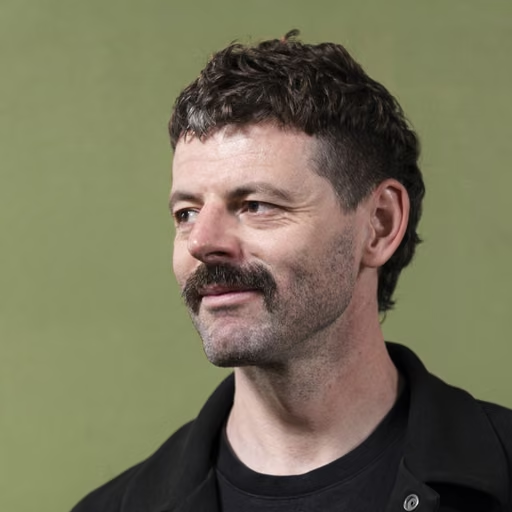
Tom Elliot - Founder
- • Fitbit: built the industry's first all-day wrist-worn heart-rate sensor (Surge); Sensor Systems Lead, Ionic. Tens of millions of units sold on hardware I developed.
- • INFARM: Head of Hardware Engineering, team of 12. The equipment my team designed carried tens of millions of € in deployed capital.
- • Senic: Head of Engineering, shipped connected consumer hardware.
- • FluidSEO: bootstrapped B2B SaaS to $3k MRR at 95% margin. Runs on about an hour a month, 3 years and counting.
Two months old. Two weeks of it building. Seven users are installed and running on real projects off a fortnight of engineering, and three have already sent feedback back. The rest of the time went to validating the problem with 25+ engineers, a two-week San Francisco trip that produced the entire pilot cohort, and the investor relationships behind this round.
The insight: AI-EDA startups build for the design file, because that's the artifact a software founder can see. The engineer's real job is the twenty decisions around it and the context that has to survive between them. coscope exists because I've made those decisions for twenty years and know the limitations of these tools first hand.
06 - Business model
$1,200 per engineer, per month.
Annual SaaS seat, sold to the engineering lead. Design partners get their first months free, then 50% pricing ($600/mo) locked for their first year.
Payback in one catch
A routine board revision burns $3k-12k of senior-EE time; the $50k respin from the problem slide would have paid for the seat for 3 years.
Priced against alternatives that charge more for less
Quilter quoted a prospect $5k for a single board spin, layout only. He declined. Bootloop's $10k/year is "too expensive for startups". A coscope seat covers the whole workflow for $14.4k/year.
A 5-EE team is a $72k/year account
Seats expand as the team hires (3,000 open roles in the segment).
Pilot users are asking to pay
One founder turned down free access on the grounds that a paid relationship keeps the feedback honest: "once I feel I'm not getting what I'm paying for, that's when it gets real."
3 design partners = the seed benchmark
Each at 2+ seats clears 5-figure ARR before the priced round.
07 - Market
$1.8B a year: what teams already pay to draw boards.
PCB design-software revenue, 2025, and growing every quarter.
The tooling covers the drawing; the labor costs 5-10× more. An ECAD seat runs $2-9k/year, while the engineer behind it burns $10-75k/year on bring-up, debug, and review. coscope reprices the same seats against the labor, not the license.
The high end is priced out of reach: PCB-level simulation needs a ~$500k/year Cadence licence. Small teams go without, and so did Apple's Mac group, per an ex-Apple founder.
Beachhead
$40M ARR in venture-backed robotics
1,416 robotics companies worldwide (before drones and aerospace) × 2 EE seats × $14,400/year, with 3,000 hardware roles open across the same companies.
08 - Why now
A new buyer, and a bigger one than the tooling market assumes.
-
1
The buyer is new. 500+ robotics companies have been founded since 2021, and they already hold $20B+ in venture funding. They design electronics in-house without entrenched process and can't staff it: 3,000 open hardware-engineering roles.
-
2
The pie is growing, not just the tooling. Canva did not take share from designers; it made millions of non-designers into people who make design work. The same shift is starting here: one pilot user has already put coscope in front of his mechanical-engineering intern, who is now doing EE work he could not have done alone.
-
3
The incumbents are busy consolidating. Over $40B of EDA M&A since 2024: Synopsys-Ansys $35B, Cadence-Hexagon €2.7B, Renesas-Altium $5.9B (~22× revenue). Their energy is going into integration and seat repricing, not new workflows.
-
4
Capital has validated the adjacent layer. $100M+ has gone into AI tools for board design (Quilter $40M, Flux $49M), all of it aimed at the schematic and PCB-layout stage. None of them carry context across the rest of the workflow.
-
5
Investors have seen the market. They haven't seen the team. A €80M European pre-seed fund has looked at many PCB and hardware design companies and invested in none of them: "right market, wrong teams so far." They called the workflow focus "differentiated vs the prompt-to-hardware approaches we've seen."
09 - Competition
Everyone else owns one artifact.
Design-AI startups
Quilter ($40M), Flux ($49M), Diode, Schematik
AI-assisted layout & schematic
Where they miss: no support on architecture and component selection. Never touch the physical board.
Single-slice entrants (YC cohort)
Bootloop, Embedder, HILstart
One workflow slice each: firmware, embedded software, a bring-up test box
Where they miss: each holds one stage. No shared context across the workflow.
EDA incumbents
Cadence, Siemens, Altium/Renesas
Simulation + in-tool AI
Where they miss: no support on architecture and component selection. Never touch the physical board.
Instrument vendors
Keysight, R&S, Tektronix
Per-instrument AI features
Where they miss: no support on architecture and component selection. No support on design.
| Who | What they sell | Where they miss |
|---|---|---|
|
Design-AI startups: Quilter ($40M), Flux ($49M), Diode, Schematik |
AI-assisted layout & schematic |
No support on architecture and component
selection. Never touch the physical board. |
|
Single-slice entrants (YC cohort): Bootloop, Embedder, HILstart |
One workflow slice each: firmware, embedded software, a bring-up test box |
Each holds one stage. No shared context across the workflow. |
|
EDA incumbents: Cadence, Siemens, Altium/Renesas |
Simulation + in-tool AI |
No support on architecture and component
selection. Never touch the physical board. |
|
Instrument vendors: Keysight, R&S, Tektronix |
Per-instrument AI features |
No support on architecture and component
selection. No support on design. |
Field check: a pilot user tried Flux.ai on a comparable board and called it "embarrassingly bad"; another's fab (JLC) caught a real error Flux's DRC missed, and Flux crashes loading his ~130-component board.
Nothing here asks a team to switch CAD tools. Every attempt to replace the incumbent has died on the same wall: the file format, the library, and years of a layout engineer's muscle memory are all sunk cost, and nobody moves a live board onto a new tool to trial it. coscope sits above whatever is already installed, so the cost of adoption is an install script rather than a migration.
coscope carries the whole loop: design files, firmware and bench instruments, one agent, any vendor's hardware. Everyone else picks one artifact and stops at its edges.
Why a better model doesn't erase this: same model, different harness. Component-by-component checking caught 100% of injected errors where naive prompting caught 5-10%. Every session also becomes structured design-vs-reality data: what was designed, what the board actually did, and what fixed it. Nobody else in the industry is capturing that record.
10 - The ask
€500k pre-seed round: rolling SAFE, first close October 2026.
6 months of runway to the seed bar: 3+ paying design partners at 5-figure ARR and a closed loop from schematic to running application. No VC round is planned; if one follows the seed benchmark it will be a bigger number on better terms.
The money buys compute and distribution.
Compute
The agent does the engineering, so the spend goes to compute rather than headcount.
Distribution: founder-led sales
Converting the live pilots into paying design partners.
Distribution: the reference build program
A new board every month through the full loop, with the journal published end to end. Each build hardens the product and markets it at the same time.
Operations and reserve
So the seed closes on our terms.
Non-dilutive leverage: German R&D grants recover up to 50% of engineering spend from year two, stretching this round without touching the cap table.
By the seed: 3+ paying design partners · 3+ published reference builds
If the reasoning stops living in one person's head, hardware teams stop being limited to the number of engineers they were able to hire. coscope lets a hardware team scale at the push of a button.
Appendix - Source register
Every number on these slides, sourced.
01 - The problem
- • Respin story ($50,000 in boards, 1 month, 15-20 engineers blocked): discovery interview, July 2026, with a senior EE (ex-Meta, ex-Fitbit). Detail: $500+/assembled board × ~100 boards; firmware team of 15-20 blocked on critical path.
- • 20-40 senior-EE hours per revision at $150-300/hr: founder analysis of 25+ discovery interviews, 2026.
- • Context living in the engineer's head: discovery interviews, 2026; recurring across robotics, audio and consultancy respondents.
- • Delay-not-dollars framing, 2-3 week China turnaround per caught error: discovery interview with the CTO of a venture-backed neurotech startup (22 PCBs in 3 months), July 2026.
02 - The customer
- • Company count, open roles, team sizes, funding stages and amounts: Robotics Registry (roboticsregistry.net), 2026. Global, robotics-only. Statistics are founder analysis of registry company-level data (n=1,416; underlying funding rounds cite SEC filings and press per company).
- • EE cost: US Bureau of Labor Statistics, May 2024 (median electrical engineer salary $111,910; $150k+ fully loaded).
- • Single-EE example: discovery interviews, 2026. $50M-raised team with no EE: accelerator screening call, July 2026.
- • The ICP is the target market, not the current user base. Live users are concentrated in consumer audio, computer vision and consultancy; the two robotics pilots in the July cohort both deferred on organizational sign-off.
03 - The solution
- • Shipping-today feature list: founder build, August 2026 (macOS/Linux, KiCad CLI, Freerouting).
- • 8 hours of constraint entry: discovery interview, 2026.
- • Injected-error evaluation (100% vs 5-10% detection): discovery interview with an EE lead at a trillion-dollar tech company, 2026.
04 - Traction
- • 7 users installed, August 2026: founder pilot log. Cohort: audio consultancy (ex-ADAM Audio senior EE), consumer audio EE (€200M-revenue company), consumer hardware EE (150-person brand), computer-vision founder (Toronto), contract EE (ex-neurotech wearable), embedded engineer (battery management), hardware/firmware consultancy founder.
- • "Embarrassingly bad" Flux comparison, correct part identification, floor plan + route: written pilot feedback, 2026-08-18, robotics consultancy founder.
- • Enclosure re-layout session and cost baseline (~$5k total including PCB spin, ~$4k engineering time; unlocks low-volume custom variants he currently turns away): live working sessions with the computer-vision founder, 2026-08-19 and 2026-08-20.
- • "Frantically checking over that 3x": pilot feedback, contract EE, 2026-08-21.
- • Discovery interview count (25+): founder interview log, February-August 2026.
- • Investor-referred pilot: Angel Invest partner introduction, July 2026. Drone flight-controller pilot (starts 2026-09-04): pilot agreement call, August 2026.
05 - Why me
- • Build timeline (~2 weeks of development; SF trip July 2026, pilot cohort sourced there): founder record, 2026.
06 - Business model
- • Quilter $5k/board-spin quote (declined): pilot user (hardware/firmware consultancy), July 2026. Bootloop $10k/year "too expensive for startups": discovery interview, June 2026.
- • "Once I feel I'm not getting what I'm paying for, that's when it gets real": pilot call, computer-vision founder, 2026-08-17. The same call flagged that a flat monthly seat may not fit small, low-cadence hardware companies: an open pricing question for that segment.
07 - Market
- • PCB design-software revenue (~$1.78B FY2025): ESD Alliance Electronic Design Market Data, published quarterly by SEMI.
- • Cadence PCB-simulation licence ~$500k/yr: discovery interview with the founder of a profitable hardware company (ex-Apple), July 2026.
- • Beachhead company count: Robotics Registry, 2026.
08-09 - Why now & competition
- • Post-2021 cohort (500+ companies, $20B+ funding) and open roles: Robotics Registry company data, 2026 (founder analysis).
- • Mechanical-engineering intern using coscope: pilot user, robotics consultancy, August 2026.
- • "Right market, wrong teams so far": partner call with a €80M European pre-seed fund, July 2026.
- • Synopsys-Ansys ($34.9B, closed 17 Jul 2025): Synopsys press release / SEC Form 8-K. Cadence-Hexagon D&E (€2.7B, announced Sep 2025, closed 23 Feb 2026): Cadence and Hexagon press releases. Renesas-Altium (A$9.1B ≈ US$5.9B, closed 1 Aug 2024): Renesas and Altium press releases.
- • Quilter funding ($40M total; $25M Series B, Oct 2025): Business Wire. Flux funding ($12M seed, TechCrunch 2021; $37M Series B, SiliconANGLE Feb 2026).
- • Flux field failures ("embarrassingly bad" on a comparable board; DRC miss caught by fab; crash on ~130-component board): pilot feedback and discovery interviews, July-August 2026.
- • Single-slice entrants: Bootloop and Embedder identified independently by a VC's diligence, July 2026; HILstart (YC, met founder July 2026); Diode: discovery interview, July 2026; Schematik (schematik.io) pre-seed (~€5M): VC recollection, August 2026.
10 - The ask
- • German R&D grant programmes, rates and eligibility: advisory call with FUNDED (getfunded.de), 2026-08-13.
- • Entity formation completing ~October 2026: tax adviser call, 2026-08-03.